
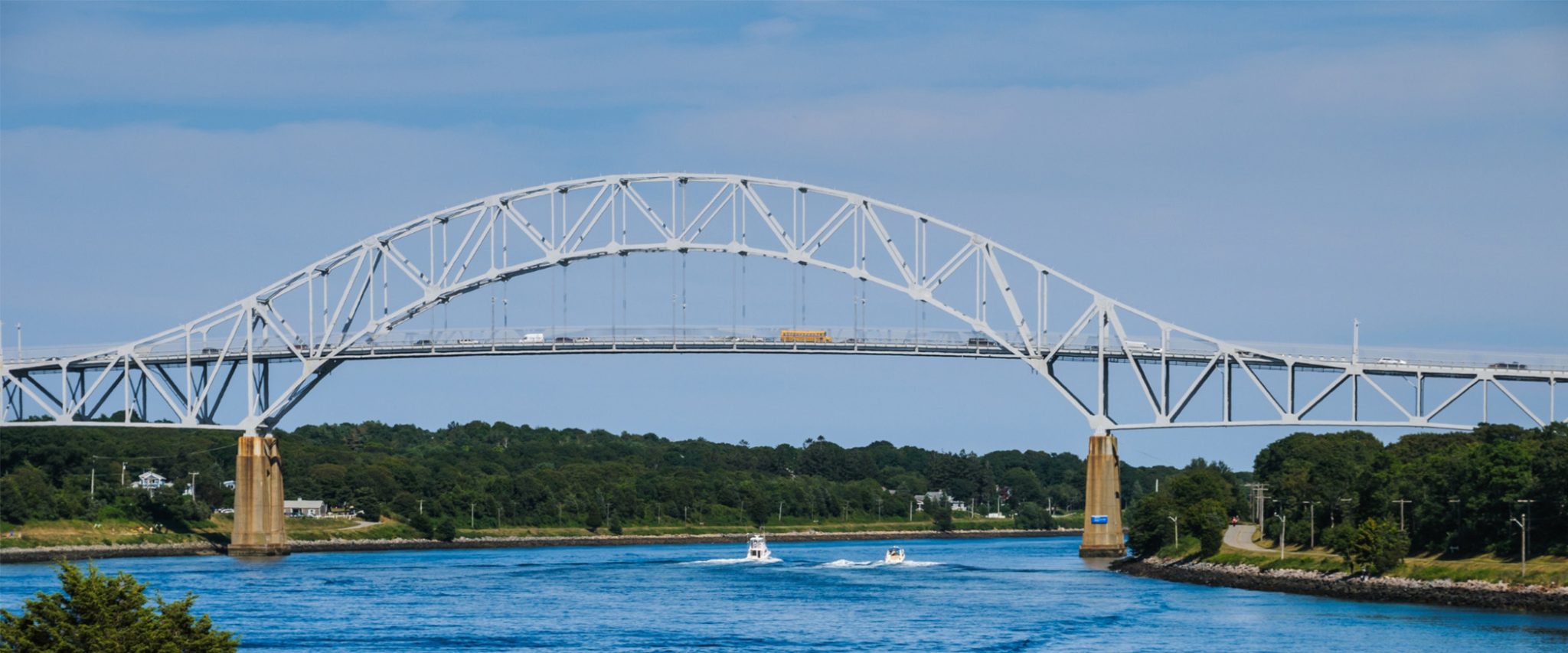
HMMH was retained by the Massachusetts Department of Transportation (MassDOT) to provide noise and air quality analyses in support of the National Environmental Policy Act (NEPA) Environmental Impact Statement (EIS) and the Massachusetts Environmental Policy Act (MEPA) Environmental Impact Report (EIR) for the Cape Cod Bridges Program. The purpose of the program is to improve cross-canal mobility and accessibility between Cape Cod and mainland Massachusetts by addressing the increasing maintenance needs and functional obsolescence of the aging Sagamore and Bourne Bridges. The proposed improvements include replacing both bridges with twin structures consisting of four through-travel lanes and two auxiliary lanes, as well as a bidirectional shared-use path on each bridge to accommodate pedestrians and bicyclists. The interchange approach networks north and south of both bridges would also be reconfigured to align with the replacement bridges.
As part of the NEPA and MEPA environmental review processes, HMMH evaluated the project’s potential effects on noise and air quality in the study area. HMMH conducted noise and air quality studies in support of the Draft and Final EIS (DEIS/FEIS) and Draft and Final EIR (DEIR/FEIR) for the proposed project.
For air quality, HMMH conducted a comprehensive evaluation of applicable federal and state requirements. The project is located in an attainment area for carbon monoxide (CO) and fine particulate matter (PM2.5) National Ambient Air Quality Standards (NAAQS); therefore, transportation conformity requirements pertaining to CO and PM2.5 do not apply for this project. However, the project was also evaluated for transportation conformity with respect to the 1997 ozone NAAQS in accordance with applicable court decisions affecting Eastern Massachusetts. HMMH reviewed the project’s consistency with the applicable Transportation Improvement Plan and Long Range Transportation Plan conformity determination prepared by the Cape Cod Commission. The air quality analyses included quantitative CO analysis based on project traffic operations, greenhouse gas emissions for the MEPA documentation, a mesoscale emissions analysis to evaluate potential regional air quality effects of the No Build and Build alternatives, and a qualitative mobile source air toxics analysis.
HMMH also completed a highway traffic noise study in accordance with FHWA’s 23 CFR 772 regulations and MassDOT’s 2011 Highway Traffic Noise Policy. The noise study included an extensive noise measurement program in 18 locations with concurrent traffic counts, TNM2.5 project-specific noise model validation, evaluation of 2019 existing condition noise levels and 2050 Design Year No Build and Build Alternative noise levels, and evaluation of noise barriers in four areas with predicted Design Year highway traffic noise impacts. HMMH prepared a Noise and Vibration Technical Report as an appendix to the NEPA and MEPA documents.
Throughout the environmental review process, HMMH supported public involvement activities by participating in the MEPA DEIR public open house and the NEPA DEIS public hearing, where team members addressed questions regarding the project’s noise and air quality analyses.
HMMH continues to support the Cop Cod Bridges Program by assisting MassDOT in conducting source noise measurements for impact and vibratory pile driving of test piles and caisson drilling as part of the Sagamore Load Testing program. These measurements are being used to support future construction noise analyses and planning.